
What is net income?
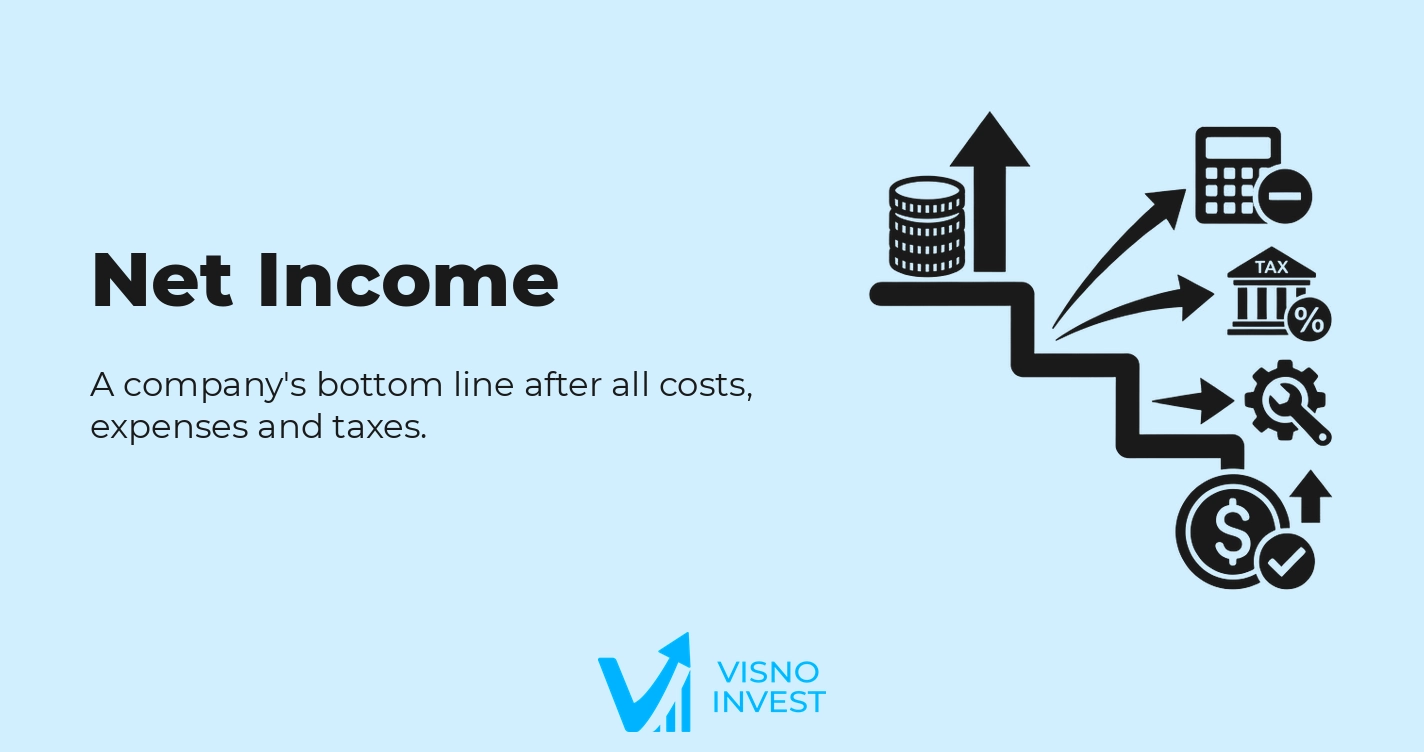
Net income is a company's bottom-line result after deducting from its total revenue all costs, operating expenses, financial expenses, taxes, and other charges. It represents the actual accounting gain for the period, available to pay shareholders, be retained in reserves, or be distributed as dividends, making it a central metric in performance analysis.
On the income statement, net income sits on the last line, after the calculation of operating income, the financial result, income taxes, and any profit-sharing items. It is the metric that summarizes, in a single number, operating efficiency, capital structure, the tax burden, and the effects of nonrecurring items.
In fundamental analysis, net income is a direct input for valuation multiples, such as the Price-to-Earnings ratio (P/E), and for profitability ratios, such as Return on Equity (ROE). It is also the accounting basis for setting dividend policy, earnings retention, and assessing the capacity for internally funded growth.
Despite its centrality, net income is an accounting metric, determined according to standards and criteria for recognizing revenues and expenses. For that reason, interpreting it requires attention to accounting policies, extraordinary adjustments, and sector differences, avoiding conclusions based only on the absolute figure reported.
How net income works and what its values indicate
Net income works as a summary measure of economic value creation in a given accounting period. Positive values that grow over time generally indicate that the company earns a profit after compensating all factors of production, third-party capital, and the tax authorities, preserving resources for equity capital.
From an economic standpoint, net income reflects the company's ability to turn revenue into residual return for shareholders, after absorbing fixed and variable costs, administrative and selling expenses, financial expenses, and taxes. It is directly related to the quality of the business model, competitive positioning, and discipline in capital allocation.
Capital structure affects net income through financial expenses: more leveraged companies tend to show greater sensitivity of profit to changes in interest rates and operating results. In scenarios of high interest rates or market volatility, the financial result can amplify swings in net income, without necessarily reflecting a structural deterioration of the business.
High net income values, when recurring and adjusted for nonoperating effects, tend to indicate good value creation and the ability to compensate equity capital. However, one-off increases resulting from extraordinary events, such as asset sales or reversals of provisions, do not by themselves support a trend of structural growth.
Low or negative values may reflect operating problems, compressed margins, an inadequate cost structure, high financial expenses, a heavy tax burden, or specific accounting effects. At capital-intensive companies or those in an expansion phase, periods of loss can result from investments and high amortization, calling for analysis over a longer horizon.
The sector context is decisive: cyclical sectors tend to show large variability in net income over the economic cycle, while regulated or utility sectors may show more stable earnings. Reading the metric should take into account the demand dynamics, regulation, cost structure, and investment cycle of each segment.
How to calculate net income
Net income is obtained from the income statement through a sequence of steps that starts with net revenue and incorporates costs, expenses, the financial result, and taxes. In simplified terms, it can be represented by the formula:
Net Income = Net Revenue – Costs – Operating Expenses ± Financial Result ± Other Results – Income Tax and Social Contribution
Net revenue is gross revenue from sales and services less returns, rebates, and taxes levied on sales. This figure is found at the top of the income statement and represents the actual volume of revenue recognized under accounting criteria.
Costs include cost of products sold (CPV), cost of services rendered (CSP), or cost of goods sold (CMV), depending on the type of business. Operating expenses cover selling, general, and administrative expenses, as well as research and development expenses and operating depreciation and amortization.
The financial result is made up of financial income (such as interest received and returns on investments) and financial expenses (interest on loans, foreign exchange variations on debt, among others). Other results may include equity-method income, gains or losses on the disposal of assets, and nonoperating provisions and reversals.
Income taxes generally include corporate income tax (IRPJ) and the social contribution on net income (CSLL), calculated on pre-tax profit, adjusted by tax additions and exclusions according to the applicable legislation.
Analysts often use net income on an adjusted basis, such as trailing twelve-month earnings (LTM/TTM) to smooth seasonal effects, and recurring net income, which excludes nonrecurring items such as extraordinary gains, restructurings, impairment, or results of discontinued operations. Analysis by business segment is also common when the company discloses a segmented income statement.
Practical calculation example
Consider a company with the following annual figures (in millions of reais), taken from the income statement:
- Gross revenue: R$1,200
- Deductions and sales taxes: R$200
- Cost of products sold (CPV): R$600
- Selling expenses: R$120
- General and administrative expenses: R$80
- Operating depreciation and amortization: R$40
- Financial income: R$15
- Financial expenses: R$55
- Other net operating results: +R$5
- Income tax and CSLL: R$35
First, calculate net revenue:
Net Revenue = Gross Revenue – Deductions = 1,200 – 200 = R$1,000
Next, obtain gross profit:
Gross Profit = Net Revenue – CPV = 1,000 – 600 = R$400
Calculate operating income before the financial result:
Total Operating Expenses = 120 + 80 + 40 = R$240
Operating Income = Gross Profit – Operating Expenses + Other Results = 400 – 240 + 5 = R$165
Then determine the financial result and pre-tax profit:
Financial Result = Financial Income – Financial Expenses = 15 – 55 = –R$40
Profit Before Income Tax and CSLL = 165 – 40 = R$125
Finally, calculate net income:
Net Income = Profit Before Taxes – IRPJ and CSLL = 125 – 35 = R$90
In this example, the company reports net income of R$90 million on net revenue of R$1,000 million, which implies a net margin of 9%. In a sector where the average net margin is 6%, this performance would indicate above-average profitability, which could reflect greater operating efficiency, better pricing, or a more optimized capital structure.
For purposes of relative valuation, if comparable companies trade, on average, at 12 times annual earnings, this company's Price-to-Earnings (P/E) multiple would be compared against that reference, always taking into account adjustments for the recurrence of net income and differences in risk, expected growth, and earnings quality.
Using net income in company analysis
Net income is widely used in company analysis as a measure of final performance for the period, serving as the basis for valuation multiples such as P/E and Dividend Payout. It makes it possible to assess whether the company generates enough profit to compensate equity capital and sustain its growth strategy.
In a fundamental analysis strategy, net income is combined with shareholders' equity to calculate Return on Equity (ROE), with net revenue to obtain net margin, and with market cap to derive relative valuation ratios. The historical trend in earnings is observed to identify trends of growth, stability, or volatility in results.
The metric tends to be most relevant at companies with a mature business model, low operating volatility, and lower intensity of long-term investment, where the accounting result is closer to the cash flow available to the shareholder. At early-stage, technology-intensive, or strongly growth-oriented companies, net income may be temporarily low or negative, calling for a greater focus on revenue, gross margin, and cash generation metrics.
In an integrated analysis, net income is often evaluated together with EBITDA, operating cash flows, net cash or net debt, and leverage ratios. This approach makes it possible to distinguish between earnings influenced by depreciation, amortization, and financial and tax effects, and the actual cash generation of the operation.
In practical scenarios, such as evaluating a company with rising earnings but strained operating cash flow, the analysis of net income should be supplemented with an examination of accounts receivable, inventories, and investments. In another scenario, a significant increase in earnings resulting from asset sales or reversals of provisions requires adjustments to calculate recurring net income, especially when trying to estimate future results for discounted cash flow models.
Net income vs. related metrics
Net income vs. EBITDA
EBITDA (Earnings Before Interest, Taxes, Depreciation and Amortization) measures operating results before financial expenses, taxes, depreciation, and amortization. While net income incorporates all of these elements, EBITDA focuses on recurring operating performance, disregarding capital structure and the tax burden.
Conceptually, net income is a measure of return to the shareholder after all obligations, while EBITDA is a measure of operating earnings before accounting and financial effects. The former is directly affected by financing decisions, amortization policy, and the tax regime; the latter isolates, to a greater degree, the operating efficiency of the business.
In valuation, net income is used in multiples such as P/E, while EBITDA supports multiples such as EV/EBITDA, which compare enterprise value with operating results. At highly leveraged companies, net income can be reduced by high financial expenses, while EBITDA preserves the view of the operation's capacity to generate earnings.
Net income vs. operating income (EBIT)
Operating income, often approximated by EBIT (Earnings Before Interest and Taxes), represents the result of the company's core activity before the financial result and taxes. Net income, in turn, is obtained after considering the financial result, income taxes, and other nonoperating results.
Methodologically, EBIT excludes the impact of capital structure, since it does not incorporate interest on debt or financial income, while net income is sensitive to these variables. As a result, EBIT is better suited to comparisons between companies with different mixes of equity and third-party capital, while net income reflects the actual result delivered to the shareholder.
In sector analysis, operating income makes it possible to assess the competitiveness and efficiency of the core operation, especially in sectors where financial management is standardized or regulated. Net income, on the other hand, becomes more relevant in analyses focused on shareholder return, dividend policy, and the capacity to generate profit after all charges.
Net income vs. free cash flow
Free cash flow measures the cash generated by operations after the necessary investments in working capital and fixed assets, indicating the resources actually available to compensate shareholders and creditors. Net income, by contrast, is an accounting measure, based on the accrual basis, which can diverge significantly from the cash generated in the period.
While net income recognizes revenues and expenses regardless of when they are received or paid, free cash flow incorporates changes in working capital, capital expenditures, and other cash flows. Companies can report high net income and constrained cash flow, for example, when accounts receivable or inventories are rising.
In company valuation, free cash flow is often used as the basis for discounted cash flow models, while net income is used in accounting multiples and in profitability analysis. Combining the two makes it possible to assess earnings quality, by checking the conversion of accounting results into recurring cash.
Advantages and limitations of net income
Advantages of net income
Net income is widely used because it summarizes, in a single metric, the combined impact of operating performance, financial management, and the tax burden. This makes it a central reference for profitability analysis, setting dividend policies, and monitoring results by managers, investors, and creditors.
In terms of calculation, net income is easy to obtain, since it appears in a standardized form on companies' income statements. This standardization makes it easier to compare companies in the same sector and of different sizes, especially when derived metrics are used, such as earnings per share, net margin, and price-to-earnings multiples.
Another advantage is its direct use in established fundamental analysis ratios, such as ROE, net margin, and payout. These ratios combine net income with other quantities, such as shareholders' equity, net revenue, and dividends distributed, providing an integrated view of profitability, efficiency, and distribution policy.
In addition, analyzing net income time series makes it possible to identify earnings cycles, resilience in adverse periods, the impact of regulatory changes, and the effectiveness of long-term strategies, when adjusted for extraordinary events and significant accounting changes.
Limitations of net income
Despite its relevance, net income is subject to distortions arising from accounting policies, estimates, and management judgments. Items such as provisions, impairment, revenue recognition on long-term contracts, and the capitalization of expenses can significantly change the reported result without immediately reflecting equivalent changes in cash generation.
Nonrecurring events, such as the sale of significant assets, restructurings, exceptional foreign exchange gains or losses, and one-off tax effects, can inflate or reduce net income in a specific period. Without adjustments, these effects make it harder to assess structural profitability trends and can lead to mistaken interpretations of the earnings trajectory.
Changes in accounting standards, such as those resulting from the adoption and updating of international financial reporting standards, can change how revenues, leases, financial instruments, and business combinations are recognized. These changes affect the historical comparability of net income, requiring reconciliation analyses and a careful reading of the explanatory notes.
In sectors with high capital intensity and long investment cycles, net income can be depressed by high depreciation and amortization, especially in the early phases of projects. In such cases, a sole focus on earnings can underestimate future cash-generating capacity, calling for complementary cash flow and return on invested capital metrics.
FAQ
What does high net income mean?
High net income indicates that, in the period analyzed, the company generated a significant profit after all costs, expenses, financial charges, and taxes. In general, this suggests good profitability and the ability to compensate equity capital, especially when the earnings are recurring, adjusted for extraordinary events, and consistent with the sector's dynamics.
What does negative net income mean?
Negative net income means an accounting loss in the period. This can result from insufficient operating margins, high financial expenses, the tax burden, provisions, or specific accounting effects. The interpretation should consider whether the loss is a one-off, resulting from investments or restructurings, or whether it reflects a structural deterioration of the business model.
What is the ideal value of net income?
There is no ideal absolute value of net income that applies to all companies. The analysis is relative and should consider size, sector, the economic cycle, invested capital, and expected growth. In general, the historical trend in earnings, their stability, net margin, and the relationship with shareholders' equity and market cap are evaluated.
Why can net income grow without an increase in cash?
Net income is determined on an accrual basis, recording revenues and expenses when they are incurred, and not necessarily when cash is received or paid. Thus, increases in accounts receivable, inventories, or intangible assets can raise earnings without generating immediate cash, highlighting the need to analyze cash flow as well.
Is net income better than EBITDA for analysis?
Neither metric is inherently superior; they are complementary. Net income shows the final result for the shareholder, after capital structure and taxes, while EBITDA focuses on operating performance before financial and accounting effects. The choice depends on the analytical goal, the sector, and the company's stage of maturity.